
Season 02 | Episode 05: Navigating Digital Accessibility as a Startup
In this episode: David and Sandi talk with John-Marc Vachon from WEtech Alliance. Discover how accessibility is integral to innovation and business growth and tips on integrating accessibility as a core business strategy.
Transcript
David: Hello, welcome to Practical Accessibility Insights. I’m David Best, and this is the podcast that helps small businesses gain competitive advantage with practical accessibility tips and tricks. With me is my co-host Sandi Gauder. Hi Sandi.
Sandi: Hi, David. How are you today?
David: I’m doing good, and I’m very excited to introduce our guest for today.
We are going to be talking about entrepreneurship. As a small business, Sandi, you’ve been around for a long time. Have you found over the years that getting accessibility resources and support is getting easier?
Sandi: Oh, that’s a tough question. I would like to say yes. In certain respects I suppose so. There’s so much more information available on the web than there was when we first started in this line of work.
But I think for small businesses, entrepreneurs, it’s still a bit of a challenge because they don’t really know what they’re looking for or how to find it or where to go find it. So I’m also looking forward to this conversation with our guest because I think you might be able to maybe shed some light on it.
David: Right. Yeah. I find that when I talk to some small business owners that they wanna do everything the right way but they have a hard time finding the resources to help them. So why don’t you go ahead and introduce our guest for today.
Sandi: I would be happy to. So today we have John-Marc Vachon who is the Director of Marketing and Events at WEtech Alliance.
And WEtech is an organization based in Windsor Essex that supports entrepreneurs in that particular area. So John-Marc, welcome to the show.
John-Marc: Hi. Thanks for having me.
Sandi: Before we get started in our questions, maybe you can tell us a bit more about WEtech so our listeners know what it’s all about and what WEtech does and what your role is there.
John-Marc: Yeah, for sure. So we’re a nonprofit organization and we help innovation and tech-based businesses start, sell and scale. That’s kind of our one line kind of answer. Going into a little more detail, we’re one of 17 Regional Innovation Centres in Ontario. Our primary work, uh, we work with entrepreneurs in Windsor-Essex and Chatham-Kent.
That’s kind of our, the region. But we also work with businesses across the province through some of our more specific programming initiatives like Idea Fund and Scale Up and things of that nature.
My role personally is, as you said, director of marketing and events. So myself as well as my team, work on the external communications.
We host the events for our entrepreneurship and technology ecosystem. Yeah, just anything external. Our website, our email communications, social media marketing, print advertising, any of that kind of stuff is kind of in my department.
Sandi: So when you say tech, are you talking about software, hardware, digital? Like what kind of companies would you be working with?
What kind of products or ideas or solutions do they typically work on?
John-Marc: Yeah, great question. And that’s one we get asked a lot. Like when people hear the word tech, you know, they think of something very specific. So yes, all of the above. Actually hardware, software, but not only tech. Even though tech is in our name, we also very much work with innovative companies that are less traditional technology companies, but are creating innovative products, scalable products, things that have intellectual property attached to them that can be patented, that are their own unique products.
So for example, we wouldn’t work with a traditional web development company because it’s not patentable. They’re working on a product for somebody else. However, we do have some web dev type companies that we work with that are creating their own intellectual property that kind of would fit into who we work with.
But there’s also a lot of companies that we work with that you wouldn’t ever think of as tech. But a common phrase that a lot of people say these days is, every company is a tech company nowadays with the integration of and tech adoption.
But it’s also the innovation side of things where you’re creating something novel, something new, something that doesn’t already exist, or you’re iterating off maybe a legacy product or service or something that’s been around a very long time, a new way of doing it.
Sandi: Yeah, you’re right there. It is hard to run a business in this day and age without tech being some part of it, and I think that’s only going to grow with AI coming on board in the next few years. So what does digital accessibility mean to you, both personally and professionally? How does it shape your work?
Does it come up in your daily conversations?
John-Marc: Absolutely though not limited to digital accessibility. More broadly, I’m on the board of directors for an organization called John McGivney Children’s Centre. They provide services to and support for children with disabilities, a wide ranging offerings of services from speech and language therapy, audiology services, things like coordinating services and counseling, autism services, physiotherapy, uh, on and on and on.
So I originally was first introduced to John McGivney Children’s Centre way back in, uh, 2015, which was the year I started with WEtech. The executive director at the time reached out to our team at WEtech Alliance and invited us out for a tour.
And to sing some Christmas carols with the kids. So we jumped on that opportunity. It was an amazing experience. All the, the kids in the gymnasium, we sang carols and they got a tour of their facilities and were just blown away by the amount of work they do, the, the impact they have. And that really kind of stuck with me.
And then from there was invited to join the board of directors. So I’ve been on the board for several years now. And so just being exposed to the, the children and the work they do has really kind of informed both personally and professionally. It’s made accessibility more top of mind for me.
And then professionally, my job is all about communication. So the, the more effective we can communicate with the widest audience, the better. And not to toot David’s horn too much here, but every conversation I’ve had with David over the years, I’ve learned so much more.
I really believe in when you know better, you do better, and it’s a continuous process, especially when it comes to accessibility. And accessibility is not a checklist type of thing, where you get to a certain point and then you kind of brush your hands off and say, okay, I’m done, uh uh, I’m there.
It’s a continuous improvement. Every day I’m learning something new. From conversations with David to like reading his blog. To his social media posts, attending his workshops and webinars, and even listening to this podcast, I learned something new literally every single time. And like I said, when do you know better, you do better.
Sandi: Progress over perfection is one of the mantras of the digital accessibility field. So you’re right, but it is a journey. You start with becoming aware of it and then you start figuring out how to do things differently and you’re always learning and you’re always making things better.
David: Absolutely. And that’s encouraging John-Marc, because I find that in my role as an advocate, we tend to focus on problems. I can’t access the website or I can’t do this. And one of the challenges we need to do is have an open dialogue so that we learn from each other. So I also learn a lot when I’m working with different organizations.
I learn a lot about the struggles they have in trying to be competitive. So the question I have for you is WEtech is an alliance. What does that mean and what partners and mission does WEtech have?
John-Marc: WEtech Alliance has evolved a lot since it was originally created. Really, honestly, we, we, we’ve talked for years now about maybe updating our name, rebranding a little bit because it can be kind of confusing.
So originally the tech community came together to focus their efforts collectively. Whereas now it’s helping innovation and tech-based businesses start, sell and scale. So it’s much more advisory service based to the, the broader community of entrepreneurs and businesses. Whereas before it was almost a little bit more like a peer group type of setup.
It’s really evolved over the years.
Sandi: We often speak with business owners, entrepreneurs, like the people in your alliance, about how they incorporate accessibility into their business. And most people, I think most people are nice people and they wanna do the right thing, but when it comes to actually putting things into practice, they don’t always take that conversation around accessibility and actually make it happen in their business.
So what kind of conversations have you had or do you hear with your, the people in your alliance around accessibility? What do you think is stopping them from actually implementing accessibility into their workflows or their products or services?
John-Marc: Well, I think I’ll start with something that, uh, actually forget if it David or Sandi that said earlier in this conversation about you don’t know what they’re looking for or where to find it, and I think that is probably the number one barrier. I’ll also add a little bit of a disclaimer here. I don’t work as much directly with our clients nearly as much as our venture services team does. I’m more focused on the external communication side of things, but that’s not to say I don’t, but just not to the extent that our venture services team does.
So I, in preparation for this podcast, had a conversation with our director of venture services just to kind of pick his brain ’cause he and his team work much more closely with the entrepreneurs around this. And he said that accessibility isn’t something typically that’s top of mind for a lot of our entrepreneurs, unless they’re specifically working on an accessibility focused product.
The largest percentage of the companies we work with are probably in the startup, the earliest kind of stage company. They’re really just trying to survive. They’re trying to make it to launch the product. They’re really often focused on their MVP or minimum viable product, and with the emphasis on minimum.
So they’ll try to get the minimum viable product out there to launch and then go back and kind of address the, the shortfalls that are there, including accessibility down the road. So I think there’s so many fires to put out, if you will, running a business, and it’s just really hard to get to everything all at once.
And I can speak from personal experience. In my many, many conversations with David, I’m often apologizing for not being where we’d like to be as an organization when it comes to accessibility. And it’s not because it’s not important. It’s been on my to-do list for a very, very long time. It’s just like trying to get everything, you know, there’s not enough hours of the day basically to get everything accomplished that we want to, and that’s not just on accessibility, that’s on a million different topics.
Sandi: So let me ask you a question. In the accessibility space, we don’t consider an MVP unless accessibility is part of it. So I guess my question to you is, when they’re putting together their MVPs, do they think about things like privacy or security? And is that part of what they think about when they’re trying to create an MVP?
John-Marc: Not as much as, as they should, truthfully, and that’s why I say it’s not specific to accessibility. Everything else is a priority, and accessibility isn’t. MVP when you that word it, it really means the minimum, like minimum viable product. So they’re trying to get the minimum out there because there are so many different elements that they’re trying to, you know, juggle at one time.
It’s really not the case where it’s everything’s important, accessibility isn’t. You know, cybersecurity, accessibility, all the, all the different elements that go into it are weighed and juggled and you know, it’s, it’s a constant effort to improve. I really love Jason Pomerleau’s approach from Elev8 Web Studio, and I heard it here actually on this podcast when I was listening to Jason’s interview with you, where he was asked about how do you incorporate accessibility into your product.
And I love his business’s approach to it, where he said, we don’t make it a line item. Accessibility is not a, a line item on an invoice because in that case, people could potentially just say, you know, uh, budget’s tight. Let’s just, let’s chop that part out of it. He’s like, we bake that into everything we do. It’s part of everything we do, and I absolutely loved that approach to it.
It’s not a line item that can be added or subtracted or scaled back based on budget. It’s, hey, we’re gonna build a website for you. It’s gonna be accessible. It’s so, I really, really like that approach.
Sandi: So how do you think we get entrepreneurs, even startups, to think about accessibility from that perspective?
Like it’s not a line item, it’s just something we build into it. Just like they’re gonna start building cybersecurity, privacy, and all the other basic things into their product or service. What do you think we have to do to change the mindset so that they actually start thinking about it earlier rather than later when it becomes so expensive and difficult to cram it into something.
John-Marc: Great question. I’ve given this some thought and I think I really like, actually, again, I’m going back to David, hid head is gonna get huge here, but David has done an amazing five-part guest blog post series for us, and we just launched our second one, and it’s kind of talks about dignity and marketing and building trust, integrity.
That really kind of resonated with me, certainly because a large part of my role is marketing and communications, and I love the approach of it where it’s almost similar to SEO, search engine optimization. It’s not all that dissimilar to accessibility when you’re really thinking about it from a marketing perspective.
Like the ultimate goal of both is to make it easier for people to, number one, find you and number two, engage with your content. And when you kind of look at it that way, it makes business sense. And David did a great job of articulating that in his blog posts for us. It makes business sense to incorporate accessibility into your product, into your communications, into what you’re doing.
Getting more people, more eyeballs, more listeners, more reach, more interest in your product, your service, your offerings is never a bad thing. So when you can improve that, all the better. So I really think maybe the way we frame it, like I said, I love the way that both David approached that and also Jason when with, as a business owner, it’s not a line item. It’s something that’s built into your, your KPIs, your goals, your targets, your messaging.
Sandi: It becomes a habit, but it’s how do you get people to that stage? I think is the challenge that David and I have experienced over and over again through the years is people want to do the right thing, but either they don’t know how to do it or they think it’s somebody else’s job, a lot of the times.
I mean, I’m a web developer as well, our agency is very similar to Jason’s. We have exactly the same approach where you get an accessible website whether you like it or not, and whether you know it or not. But it’s how do you get people to even make that their habit, I guess?
David: Well, if you wanna humor me for a moment, I will give you my opinion on this. I think the problem we have is that we are currently in, in Ontario and across Canada, fighting a war of cultures.
We seem to have an attitude in Ontario that if we pass laws, we pass policies, then everything’s good. However, it, it doesn’t seem to work that way because it’s the leadership that needs to promote the policies. And if there’s no follow up activity to support those policies, nothing happens.
I’ve talked to a number of the small business owners and when I show them how easy it is to make the basic websites accessible, they are amazed at how simple it is. And they say, we’ve never been told this in our education, university and college. They never were taught how to do this. And the Ontario government provides grants for small business startups, and they’re not following up with these small businesses to make sure that they actually comply with the accessibility standards.
The business owners tell me that they’ll get around to it. Accessibility is something that they wanna do, but it’s something that they will get to eventually. So I think our leadership in business and government needs to take a closer look at their role of responsibility and start mandating that education takes place because education is what really drives our productivity in Canada.
On the other side of the divide is that we have an apathetic public. We’ve given up, basically. I have written letters and emails to companies and governments about accessibility issues, and again, either no response or they say, yeah, we’ll get to it someday.
And so we have this ever widening gap between a culture of arrogance on the leadership side and a culture of apathy on the user side, the public side. So I guess the question I would have for you John-Marc, is what role going forward do you think an organization like WEtech could play in helping to educate students at the very earliest age that are coming into the entrepreneurship role and helping them understand that investing in human capital is just as important as investing in technology?
John-Marc: Yeah, that’s a great question. The advocacy and awareness side of things I think is, and like you said, you kind of would get, you get tired of it and you’re, you kind of beat your head against the wall so many times when you’re, you have these conversations over and over and over again. And I kind of it reminds me of the last conversation we had where you kind of almost apologized for being a thorn in the side of like constantly you felt it, like you were kind of being a hindrance or whatever.
And I said, absolutely not. Like, I appreciate so much every time you, you email me or call me or, or just kinda even a, a social media post or anything about opportunities. So it’s about like the opportunities for improvement versus punitive. It’s an education, just an awareness piece for me. And, but I like learn something new absolutely every single time.
Sometimes you think you’re doing the right thing and it turns out you’re actually doing something that, it makes it harder for certain people. I think back to a conversation we had a long time ago about, there’s plugins, there’s apps out there for accessibility that you can add to your website to supposedly improve accessibility for people.
Uh, a community organization that we work with had incorporated it into their website, and that was the first time I had seen it and I, I started seeing it this exact same app more and more on other people’s websites. So after doing that research, I also reached out to several people in the, the community that would utilize this feature and everything I heard was positive about it. I was like, yeah, this would be great.
So I incorporated into our website and in a conversation with you, you said, this actually makes it so much worse for me to, to access your website ’cause it takes over my screen reader and actually prevents me from doing the things.
Well, I had no idea about that and so I was so appreciative of you reaching out to tell me that. ’cause here I am thinking I’m doing something that would help. And I’m sure it does help in certain cases for certain people. There’s not a one size fits all forever. It’s not just accessibility is one thing.
It’s different things to different people with different needs. So I value it so much. The advocacy and the awareness piece is so important.
David: I just don’t understand why it’s taken so long for leaders to understand this because the AODA was implemented and passed into law in 2005 with the expectation of full inclusion by 2025.
Here we are in 2026, and I could go to a student that’s graduating from the University of Windsor, Ontario or St. Clair College, and they, I bet will tell me they don’t know what a screen reader is. So the question I, I’m always trying to figure out is, are leaders at the top that are making these decisions, whether it’s providing grants or providing training, providing marketing strategies, how do we get our leaders to understand that they need to learn this as well?
John-Marc: Yeah, that’s a great question. I mean, I wish I had the answer for that. Part of it is the individual I think in place has to be passionate about it. And that you can say that about absolutely anything, right? Like sometimes in our roles, in our jobs, in our lives, there’s things that we have to do versus things that we’re passionate about or even interested in, really.
Like when things are punitive, it resonates differently with people. Again, you made a great case for it about like it’s a smart business decision to include accessibility into your offerings. You can reach more people. It shows your empathetic, like all of the things you articulated in the, the recent blog posts.
As the receiver of that information, you hear it that way, it’s much more digestible. It’s much more real and it makes much more of a business case for it. It’s similar actually, kind of to like building codes for example. Those are like the minimum standards like Ontario business building codes. You have to do build it this way, you have to do this, that X, Y, Z.
Those are the minimum standards just to pass your inspections and things like that. But you should always strive to be better than that. Those are the absolute minimums. So kind of similar with accessibility and the AODA. These are the minimum things that you should have, but we should always strive to be better and do better than that.
So I do feel like having the right leaders that are passionate about the, the subject is important and framing it the right way. Instead of punitive show of opportunity. And like you said, it’s not as hard or as daunting as it’s perceived to be to to make these changes.
Sandi: I think one of the things that we might see shifting things a little bit is some of the legislation that’s coming into play in the EU, certainly all the litigation that happens south of the border. I think we’re gonna start seeing more accessibility is part of the procurement process. So people who are putting out RFPs or RFQs or requests for bids or whatever you want to call it, they’re gonna start looking for proof that the vendor that they’re buying from has an accessible product or service.
The pushback is gonna go now down the chain to the vendors who are producing things. It’s almost like this new recycling thing that is happening now in the province where it’s the producers that are now responsible for dealing with recyclable materials. So it’s almost gonna be the same thing in the accessibility side of things where the vendors who are producing the goods and services are going to become responsible for making sure that their product or service is accessible.
If you’re gonna sell me software, well that software better be accessible and you’re gonna have to prove that it’s accessible. Do you have those kinds of conversations with your members? Do you have conversations with them about that whole procurement side and how they can differentiate themselves if they are producing accessible products or services?
John-Marc: Yeah, absolutely. Whether it’s about accessibility or anything is about differentiation. How’s your product different? How’s your service different?
Again, it’s not about getting to a point and then being done with it. It’s constantly evolving, constantly improving every day, doing a little bit better. We’re not tech auditors. We’re not tech experts. We work on the business side, whether it’s mobile app or a website or something that’s not as technical.
It’s about the business side of things. So we work with a group of growth coaches that are external subject matter experts, experts in their fields. So if there’s a question that comes up or there’s an opportunity that comes up that we’re not experts in, we have a roster of growth coaches that we can work with as it comes up. It’s on a case by case basis as the company has a need, we try to find somebody that is, is the right fit to have those conversations with them and the opportunities.
But baking as much of that into the the product versus as an add-on. It just, it’s a shift in mindset. Our startup advisor on our team does a great presentation, uh, called Innovation Blueprint, and she talks about MVPs and how it’s like a, a pyramid.
And instead of building one layer at a time of that pyramid, you build a section of each element of that pyramid so the minimum portion of it isn’t building one layer at a time. It’s building a slice of every layer at the same time. So accessibility, as an example, is a part of a, the core offering of your MVP.
And then you continue to grow and continue to evolve and continue to add more and more as you go versus having none and then trying to add it after the fact.
Sandi: I totally understand. It’s challenging at the beginning trying to think of everything you’ve gotta do and make something work as a business. So I totally understand how it can be overwhelming at the start, but it’s encouraging to hear that some people might be thinking about it.
It might not be perfect at the start, but at least it’s there. Even just having that in the back of your mind as you’re starting out makes all the difference in the world, because at least if you can’t incorporate it right at the get go, then you know that you have plans down the road that phase two, phase four, this is where we’re gonna start building it in, but you’re not having to break things to, to make things, so to speak.
David: Well, I wanna thank you so much, John-Marc, for coming on and taking our questions and putting you on the hotspot for a while. It is a challenging area and I don’t think anybody has any real definite answers, but as long as we keep working together, I think we can keep making progress. Do you have any resources or contacts you would like to leave with our listeners?
John-Marc: Oh, for sure. Yeah, you could check us out on our website, WEtechAlliance.com. So if you’re interested in learning more about becoming a client, you can access that. We have tech jobs opportunities in the region that you can access there. In the upcoming events, either ourselves or our community partners, as well as David’s guest blog post series as as on there as well.
So it’s kind of our one stop shop. And then from there you can also access our social media channels and yeah.
Sandi: So John-Marc, thanks again for joining us on the show. Before we wrap up, we have one question we like to ask all our guests, and that’s what action or tip or suggestion you’d recommend to entrepreneurs, small business owners, startups, what step they might take when they’re thinking about bringing accessibility into their business strategy.
John-Marc: Never stop learning and don’t be ashamed or embarrassed of what you don’t know where you’re maybe deficient in a specific area. Personal example, actually from this, speaking again about David’s guest blog post series that he did for us. When David first shared that with me, I loved it and the second thought I had was should this wait until our website is updated because I know that we’re not where we need to be. There are deficiencies that David has pointed out, for example, on our website.
And I thought is, if I put this out now, is it kind of a do as I say, not as I do? Like am I being hypocritical by putting it out there? But ultimately said, this is just too important to hold off on. And so I wanted to put it out there and give that information to people, show them the opportunities that are there and not making it about us or me of not being where we wanna be. Because again, it’s a, it’s a process. It’s a, it’s a journey.
You’re never done, so I can’t wait till I’m where I want to be because I’m never gonna be where I want to be. It’s always about improving, so just don’t be afraid or embarrassed or shamed into inaction, I guess would be my kind of biggest takeaway. And that’s based on my personal experience because I think it’s, that can be a tendency for people, right?
Like they don’t you, you don’t want to be uncomfortable or you don’t wanna be, you don’t wanna do the wrong thing. And I would also say, kind of flip it a little bit as well, David, don’t stop doing what you’re doing and Sandi, don’t stop doing what you’re doing. I know it can sometimes feel like you’re hitting your head against a wall and you’re not, you’re not getting anywhere with these conversations, but it resonates and it makes a difference, and your advocacy is so important. Never stop championing accessibility.
Sandi: Good advice, and thank you for the words of encouragement. It’s nice to know that actually when we do speak, there are people out there listening and a light bulb gets turned on and they start doing even one thing a little bit differently.
Well, thanks again, John-Marc, I really appreciate you taking the time to chat with us today. It’s always good to find out what it’s like on the other side of the table, what it’s like to try and encourage people to think about accessibility, even in the smallest moment.
So it’s been great. Thank you again.
John-Marc: Awesome. Thanks so much for having me.
David: The views, thoughts and opinions expressed on this podcast.
Are the speakers own and do not necessarily represent those of the podcast team and partners. This podcast is for information and learning purposes only. The Practical Accessibility Insights podcast is hosted by CMS Web Solutions. The intent of this podcast is to raise awareness for practical advice and strategies for making digital and physical environments more accessible to everyone.
Thank you for joining us in this time of discovery and sharing for a more inclusive society. If you have questions or comments, you can email us at info, I N F O, at david dot best or Sandi, S A N D I, at CMS Web Solutions dot com. For more information and resources, go to www.CMSWebSolutions.com or www.BestAccessibility.consulting.
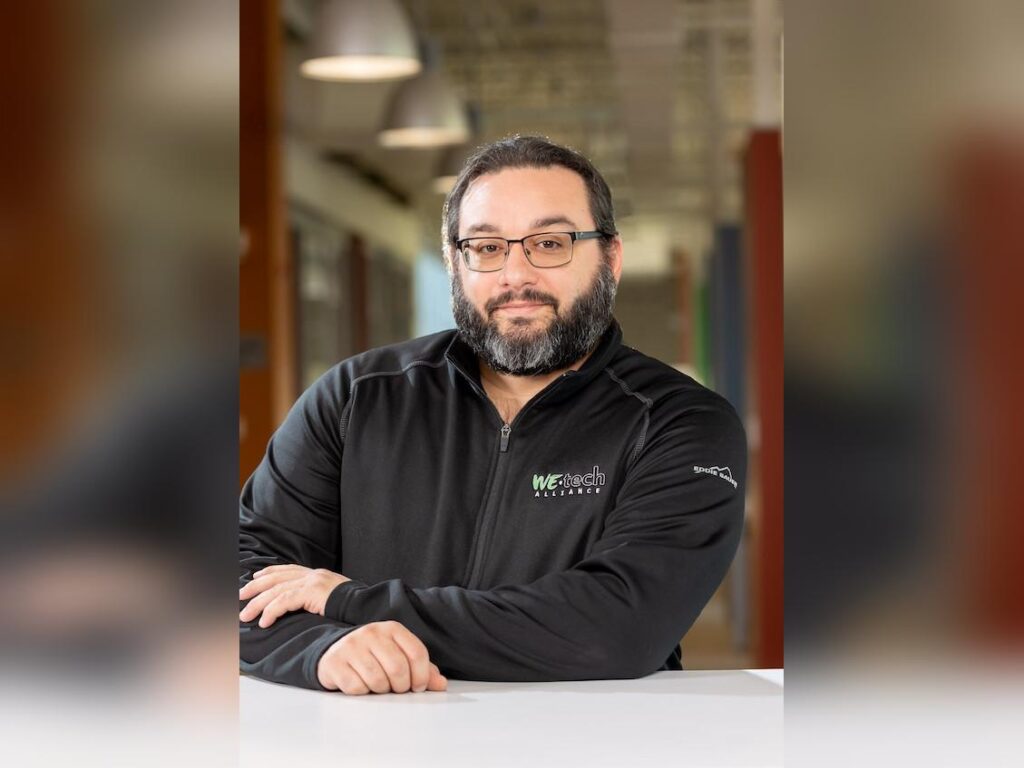
Guest Speaker
John-Marc Vachon
John-Marc is the Director of Marketing & Events for WEtech Alliance, a non-profit organization that helps innovation and tech-based companies start, sell and scale. He’s also a Board Member for John McGivney Children’s Centre, an organization that provides services to support children with disabilities.